Closing meeting in Abruzzo
We started in Galicia, in a community that had been managing its woodlands for generations. We ended in the Abruzzo Apennines, in a village of 301 people that was once home to nearly 2,000.
From 13 to 16 September 2025, the Wonder Commonlands partners gathered for the closing meeting of the project in Anversa degli Abruzzi, a small mountain municipality in the province of L’Aquila, historically shaped by collective land use and pastoral practices. The choice of location was not incidental. Like so many places across the European interior, Anversa carries the weight of decades of emigration alongside a remarkably dense heritage of ecological and cultural knowledge. Hosting the meeting there made it possible to think about commonlands as something lived intergenerationally, in the flesh, more than an abstract concept.
The meeting was curated jointly by Slow Food Abruzzo and the Department of Political Science of the University of Teramo, and was organised around the farm of one of the comuneras involved in the project, Manuela: a woman with more than thirty years of experience in the collective management of mountain common pastures, who had already been part of the opening meeting in Couso. That continuity was a reminder that this project has always been as much about relationships as about research.
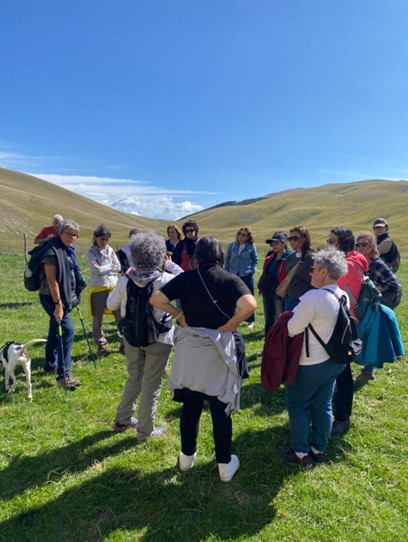
The second day was dedicated entirely to field visits. In the morning, the group travelled up to the high-altitude pastures of Chiarano, where regulated transhumance is still practised today under the legal framework of usi civici , the system of civic uses that has governed collective access to land in Italy for centuries. Historian Alessio Rotellini, agronomist Manuela Cozzi and shepherd-economist Nunzio Marcelli guided the visit, each bringing a different layer: historical, institutional, ecological, technical. The area is now managed by the Abruzzo, Lazio and Molise National Park, which took over responsibility from the regional government in 2021 in part to protect the ecological corridor for the Marsican brown bear.
What stayed with the group was something simpler than all of that: the women. In this territory, women rarely hold formal governance roles in the management of pastures and commonlands. And yet they have carved out significant space as custodians of traditional ecological knowledge, as innovators, as the people who run the agritourism, the cheese production, the direct sales. A young cheesemaker called Viola Marcelli, who left and came back, and whose cheeses now win awards and are exported internationally, is as much a part of this commons as any legal framework.
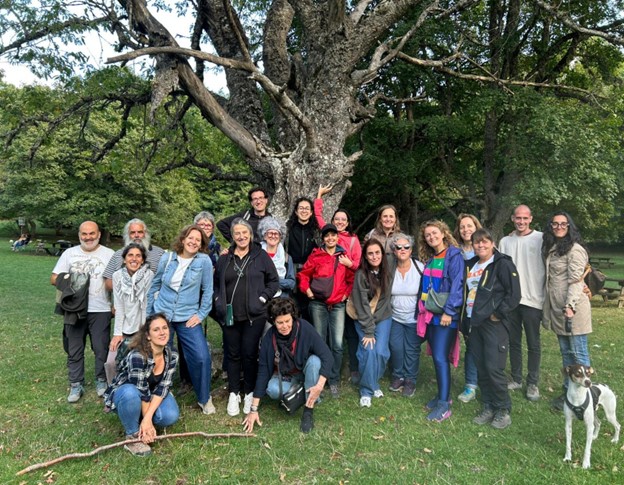
In the afternoon, ethnobotanist Aurelio Manzi led the group through the Bosco di Sant’Antonio, a beech forest that was already a protected common in Roman times, consecrated first to Jupiter and later to Saint Anthony. The monumental trees bear the marks of centuries of pruning — branches cut to feed livestock in lean seasons. The forest is now a Regional Natural Reserve and part of the Maiella National Park, visited by hikers, riders and skiers depending on the season. Standing inside it, the distinction between conservation and use becomes harder to maintain.
The third day we moved to the University of Teramo, where an international interdisciplinary workshop brought together project partners, invited researchers, students and local stakeholders. Partners presented the situation of commonlands and women’s participation in their respective countries: Spain, Bulgaria, Greece, Portugal and France. This allowed for tracing both the deep differences and the stubborn similarities across legal systems and territorial contexts.
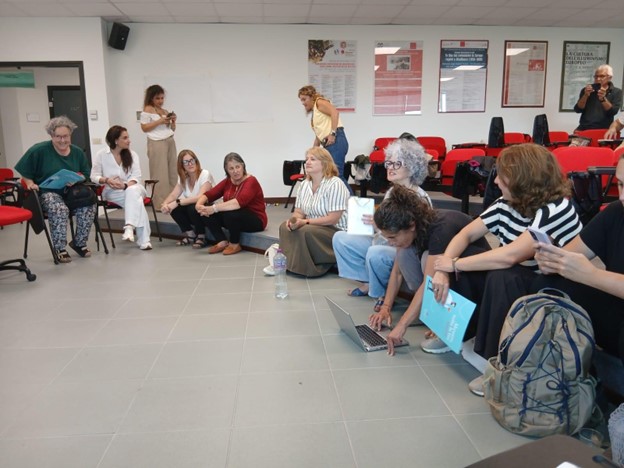
The afternoon was structured as a fishbowl discussion, opened with a simple prompt: tell us about your own experience as a woman in the commonlands of your territory. What followed was not a debate but something closer to a collective map — of labour, of care, of knowledge that has been transmitted without ever quite being recognised. A graphic facilitator built a visual record of the session in real time, tracing the connections between stories that had come from very different places and arrived, often, at the same point.
Across all contributions, a few things kept coming back: that commonlands are relational spaces before they are legal categories; that women sustain them in ways that formal governance structures rarely see or reward; and that the future of these territories depends less on policy than on the capacity to value what has always been there.
Full minutes of the closing meeting available here.